


Art takes off
RER helicopter rescue service calendar 2025
“Art Takes Flight” – Celebrating People, Professionalism, and Hearts
Introduction to the work
Firstly, users of this work are informed that references to places of cultural, architectural, artistic, and picturesque interest are purely fictional.
The “L’Arte che decolla” (Art Takes Off) project was born from the idea of celebrating the people and various professions that revolve around the world of helicopter rescue, forming an integral part of it.
As with any complex activity, the regulations and standards governing its activities are becoming increasingly stringent. Like the cogwheels of a clock, the skills of the medical and aeronautical personnel are essential to the achievement of the objective of the complex mechanism’s operation and maximum precision.
But beyond the gears and regulatory mechanisms, there is an ecosystem of individuals driven by passion and ready to put their skills at the service of the community.
Steve Jobs liked to say that your work will fill a large part of your life, and the only way to be truly satisfied is to do what you believe is great work. And the only way to do great work is to love what you do.
May we all achieve complete satisfaction and happiness in our work.
Giuseppe Mariggiò
Publicist, Order of Journalists of Emilia-Romagna
Avincis rotary wing pilot
Base manager, Bologna HEMS
With the patronage of:
Promoting organization:
Main sponsor:
The “L’Arte che decolla” (Art Takes Off) project was born from the idea of celebrating the people and various professions that revolve around the world of helicopter rescue, forming an integral part of it.
As with any complex activity, the regulations and standards governing its activities are becoming increasingly stringent. Like the cogwheels of a clock, the skills of the medical and aeronautical personnel are essential to the achievement of the objective of the complex mechanism’s operation and maximum precision.
But beyond the gears and regulatory mechanisms, there is an ecosystem of individuals driven by passion and ready to put their skills at the service of the community.
Steve Jobs liked to say that your work will fill a large part of your life, and the only way to be truly satisfied is to do what you believe is great work. And the only way to do great work is to love what you do.
May we all achieve complete satisfaction and happiness in our work.
Giuseppe Mariggiò
Publicist, Order of Journalists of Emilia-Romagna
Avincis rotary wing pilot
Base manager, Bologna HEMS
With the patronage of:
Promoting organization:
Main sponsor:
The Work as told by the Artist
Eleonora Ruggeri, 26, is studying social and health care at high school and is graduating in modern languages and literature in Ferrara. Her passion for drawing began at an early age. She does not attend art classes or schools but tries to learn painting techniques by studying videos posted on social media by experienced artists. She loves everything about creativity and tries to represent what she sees and dreams in her mind on her canvases.
The calendar naturally consists of twelve months and is therefore made up of twelve oil paintings on canvas. It is divided into two main themes: six paintings depict typical scenes from everyday working life at a helicopter rescue base, while the remaining six paintings are linked to the theme of helicopter rescue through the vast world of art. This is because the calendar itself comes to life thanks to the work of brushes, colors, and creativity.
– Six paintings depict typical scenes from everyday working life at a helicopter rescue base. These scenes are reproduced on canvas almost as if they were photographs taken at the moment.
The main work features the helicopter and the professionals working at the base (pilots, doctors, nurses, technicians, and firefighters). The aim is to offer interested citizens the opportunity to see behind the scenes of a helicopter rescue base, almost as if they were there to observe with their own eyes the teamwork of several people who all have a common goal: to save lives.
– Six paintings are linked to the theme of helicopter rescue through the vast world of art. This is because the calendar itself will come to life thanks to the work of brushes, colors, and creativity. The aim is to realistically combine the unique style of timeless artists such as Van Gogh and others with the reality of helicopter rescue, ultimately creating a work that blends our modern way of life with the antiquity of the past.
The primary objective of these paintings is to pay homage to art in all its facets and to promote this world, now hidden by the advent of technology, to new generations. It is also a reason to create original works, conveying messages through the use of symbols (as many artists did).
The calendar naturally consists of twelve months and is therefore made up of twelve oil paintings on canvas. It is divided into two main themes: six paintings depict typical scenes from everyday working life at a helicopter rescue base, while the remaining six paintings are linked to the theme of helicopter rescue through the vast world of art. This is because the calendar itself comes to life thanks to the work of brushes, colors, and creativity.
– Six paintings depict typical scenes from everyday working life at a helicopter rescue base. These scenes are reproduced on canvas almost as if they were photographs taken at the moment.
The main work features the helicopter and the professionals working at the base (pilots, doctors, nurses, technicians, and firefighters). The aim is to offer interested citizens the opportunity to see behind the scenes of a helicopter rescue base, almost as if they were there to observe with their own eyes the teamwork of several people who all have a common goal: to save lives.
– Six paintings are linked to the theme of helicopter rescue through the vast world of art. This is because the calendar itself will come to life thanks to the work of brushes, colors, and creativity. The aim is to realistically combine the unique style of timeless artists such as Van Gogh and others with the reality of helicopter rescue, ultimately creating a work that blends our modern way of life with the antiquity of the past.
The primary objective of these paintings is to pay homage to art in all its facets and to promote this world, now hidden by the advent of technology, to new generations. It is also a reason to create original works, conveying messages through the use of symbols (as many artists did).

This painting refers to the city of Bologna and Banksy.
I thought long and hard about which artist to choose and pair with my city.
I grew up in the countryside on the outskirts of Bologna, where my grandparents had and still have typical country houses where they raised livestock and grew wheat and other cereals.
I have always been fascinated by the countryside, and all of this has left me with what I call simplicity and freedom in my heart. I believe that Bologna can be closely linked to these words; it is no coincidence that the term “libertas” is present in the city’s coat of arms. As a teenager, I started school and found myself spending time in the center of Bologna, admiring its history and culture, but also the way it values its citizens. Bologna is a city where diversity is considered a virtue rather than a flaw, a city full of ideas and young people who fight against discrimination and assert their rights. Through my work, I am also learning about the reality of helicopter rescue, and the thing that fascinates me most is that when the radio sounds for a rescue, the helicopter takes off in no time at all. At that moment, someone needs our help, and no distinctions or judgments are made.
Banksy speaks to the people, remaining anonymous, taking the side of the community and using art to represent common criticisms and ideologies. The rats in his works represent the least listened to and most marginalized groups. Through this comparison, I pay tribute to the Italian healthcare system, which still today eliminates all forms of prejudice by providing assistance to everyone.
I thought long and hard about which artist to choose and pair with my city.
I grew up in the countryside on the outskirts of Bologna, where my grandparents had and still have typical country houses where they raised livestock and grew wheat and other cereals.
I have always been fascinated by the countryside, and all of this has left me with what I call simplicity and freedom in my heart. I believe that Bologna can be closely linked to these words; it is no coincidence that the term “libertas” is present in the city’s coat of arms. As a teenager, I started school and found myself spending time in the center of Bologna, admiring its history and culture, but also the way it values its citizens. Bologna is a city where diversity is considered a virtue rather than a flaw, a city full of ideas and young people who fight against discrimination and assert their rights. Through my work, I am also learning about the reality of helicopter rescue, and the thing that fascinates me most is that when the radio sounds for a rescue, the helicopter takes off in no time at all. At that moment, someone needs our help, and no distinctions or judgments are made.
Banksy speaks to the people, remaining anonymous, taking the side of the community and using art to represent common criticisms and ideologies. The rats in his works represent the least listened to and most marginalized groups. Through this comparison, I pay tribute to the Italian healthcare system, which still today eliminates all forms of prejudice by providing assistance to everyone.

I dedicate this painting to the Pavullo area, with reference to the work of Vincent Van Gogh.
This work is particularly close to my heart because the same landscape appeared in my mind one night as I lay in bed before falling asleep. I wanted to reproduce it on canvas exactly as I saw it in my mind, including the little church in Auvers, France, which was the subject of the painter’s famous painting (“The Church at Auvers”). For the town of Pavullo, I included the Olina bridge in the distance with three hills behind it, over which an eagle is flying, symbols that appear in the town’s logo (the images painted are, of course, my own interpretation).
I wanted to draw inspiration from Vincent Van Gogh in my own way, imagining a possible continuation, starting from the left side of the last painting he painted (“Wheatfield with Crows”).
My goal as a painter was to bring Vincent Van Gogh’s attempted suicide back to the present day, as if today’s services could somehow rescue and save him, and then tell him that almost a century and a half after his death, today’s society has made some progress in the field of mental health. I would like to tell him that, fortunately, we no longer point the finger at those who suffer from mental health issues and that there are many people who are willing to help and, above all, listen. The person with his back to us at the bottom of the painting is Theo Van Gogh, Vincent’s brother, to whom the painter was particularly fond. I imagined Theo Van Gogh upon hearing the news of his brother’s disappearance in the wheat fields, worried but in a way I think he also knew that Vincent’s fate was already sealed, that he would leave extraordinary works to society thanks to his visions and suffering.
This work is particularly close to my heart because the same landscape appeared in my mind one night as I lay in bed before falling asleep. I wanted to reproduce it on canvas exactly as I saw it in my mind, including the little church in Auvers, France, which was the subject of the painter’s famous painting (“The Church at Auvers”). For the town of Pavullo, I included the Olina bridge in the distance with three hills behind it, over which an eagle is flying, symbols that appear in the town’s logo (the images painted are, of course, my own interpretation).
I wanted to draw inspiration from Vincent Van Gogh in my own way, imagining a possible continuation, starting from the left side of the last painting he painted (“Wheatfield with Crows”).
My goal as a painter was to bring Vincent Van Gogh’s attempted suicide back to the present day, as if today’s services could somehow rescue and save him, and then tell him that almost a century and a half after his death, today’s society has made some progress in the field of mental health. I would like to tell him that, fortunately, we no longer point the finger at those who suffer from mental health issues and that there are many people who are willing to help and, above all, listen. The person with his back to us at the bottom of the painting is Theo Van Gogh, Vincent’s brother, to whom the painter was particularly fond. I imagined Theo Van Gogh upon hearing the news of his brother’s disappearance in the wheat fields, worried but in a way I think he also knew that Vincent’s fate was already sealed, that he would leave extraordinary works to society thanks to his visions and suffering.
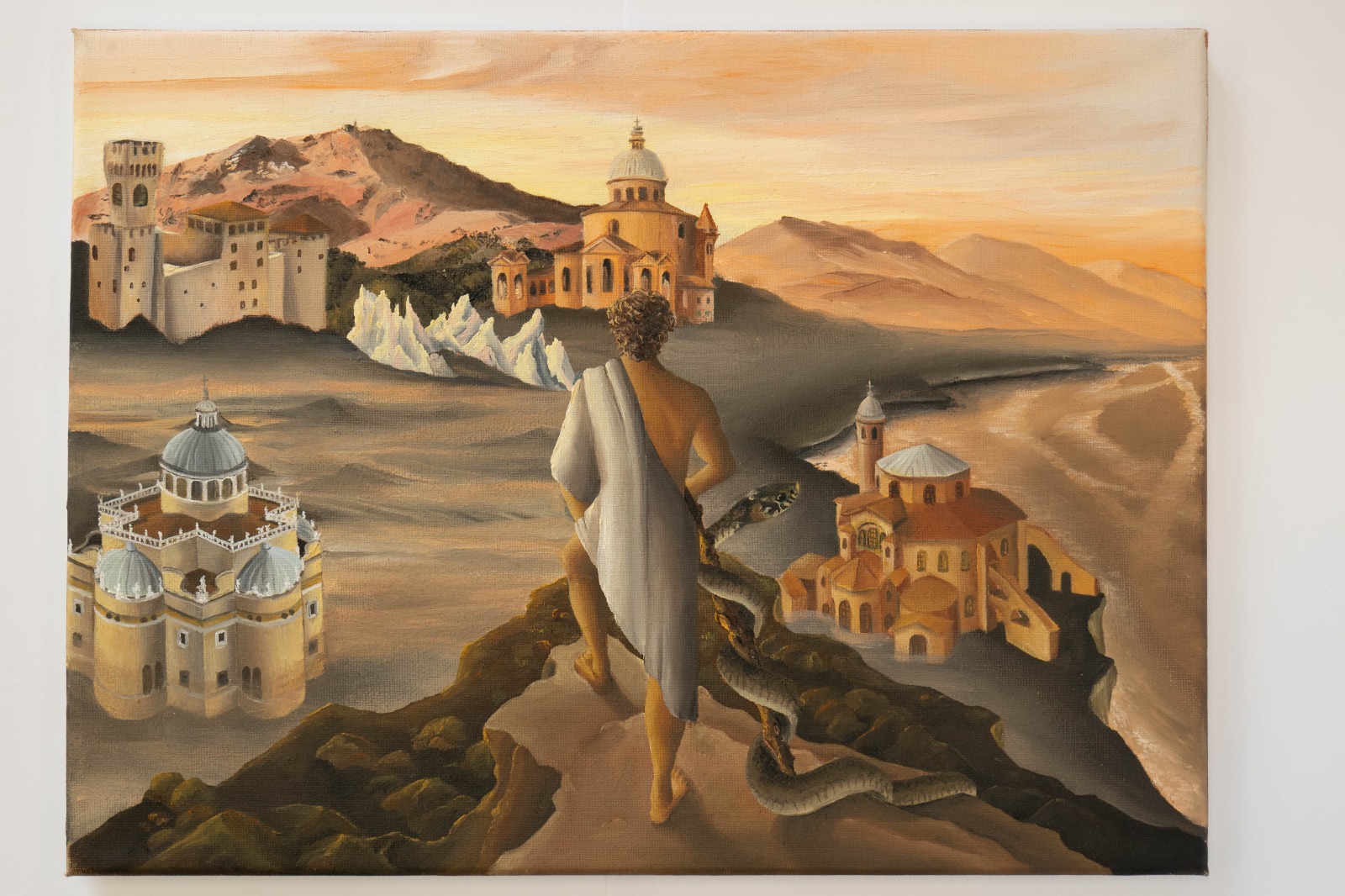
I dedicate this painting to the four helicopter rescue bases in our region, paying homage to Caspar David Friedrich.
I wanted to reinterpret the famous work “Wanderer above the Sea of Fog” from a pictorial point of view, placing the Greek god Asclepius, patron of medicine, at the center, looking down from a high peak onto an imaginary landscape with Mount Cimon emerging in the distance.
In the background, from left to right, are likely monuments typical of Pavullo, Parma, Bologna, and finally Ravenna.
I also remember when I was enchanted by Friedrich Caspar David’s “The White Cliffs of Rügen.” I am very fond of the chalk park in our Apennines because, as a child, I was taken there to collect moss for the nativity scene. I included the white chalk mountains emerging from the fog in the distance, the latter being a rather common feature of our region.
I wanted to reinterpret the famous work “Wanderer above the Sea of Fog” from a pictorial point of view, placing the Greek god Asclepius, patron of medicine, at the center, looking down from a high peak onto an imaginary landscape with Mount Cimon emerging in the distance.
In the background, from left to right, are likely monuments typical of Pavullo, Parma, Bologna, and finally Ravenna.
I also remember when I was enchanted by Friedrich Caspar David’s “The White Cliffs of Rügen.” I am very fond of the chalk park in our Apennines because, as a child, I was taken there to collect moss for the nativity scene. I included the white chalk mountains emerging from the fog in the distance, the latter being a rather common feature of our region.
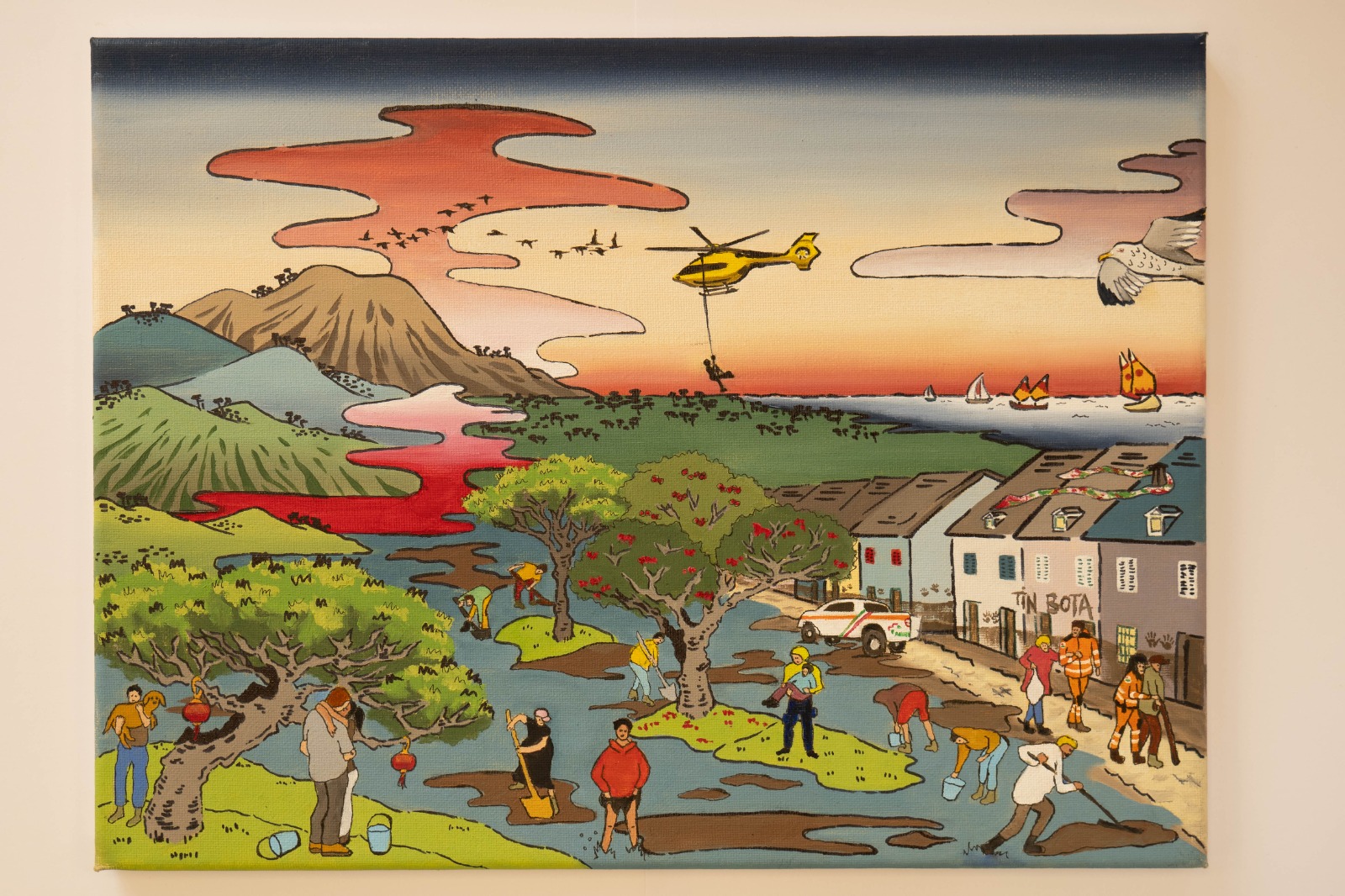
This painting is a tribute to the city of Ravenna and Hiroshige.
Admiring the works of the master Hiroshige, I was impressed by this artist’s ability to highlight the majesty of nature in contrast to the uniqueness of human beings.
Referring back to this technique, I wanted to dedicate my thoughts to the flood that struck Romagna in May 2023.
Feeling physically and psychologically close to what happened, I couldn’t help but reflect on how, in an instant, nature can wipe out years of hard work and sacrifice.
At the same time, I remembered when, a year ago, a dear friend of mine from Forlì went out onto the street below her house to clean up the mud alongside lots of other people and volunteers.
I researched and collected the most touching images of those moments and, transforming them into the artist’s typical style, I placed those very people in the painting.
I hope this painting conveys a single message: despite the power of nature, which always prevails, solidarity and the good spirit of people have given hope that these people will find the strength to carry on.
Admiring the works of the master Hiroshige, I was impressed by this artist’s ability to highlight the majesty of nature in contrast to the uniqueness of human beings.
Referring back to this technique, I wanted to dedicate my thoughts to the flood that struck Romagna in May 2023.
Feeling physically and psychologically close to what happened, I couldn’t help but reflect on how, in an instant, nature can wipe out years of hard work and sacrifice.
At the same time, I remembered when, a year ago, a dear friend of mine from Forlì went out onto the street below her house to clean up the mud alongside lots of other people and volunteers.
I researched and collected the most touching images of those moments and, transforming them into the artist’s typical style, I placed those very people in the painting.
I hope this painting conveys a single message: despite the power of nature, which always prevails, solidarity and the good spirit of people have given hope that these people will find the strength to carry on.

I dedicate this painting to the Emilia Romagna region in homage to Keith Haring.
I was born and raised in the countryside near Bologna. Every Christmas, all my relatives would stay at a community for people with disabilities in the hills of Tolè, and in the summer they would take me on vacation to the Romagna Riviera. I thought I knew my region quite well, but this project has allowed me to discover many new things and places to visit. As a native of this land, I have always felt a close bond between Emilia and Romagna, two worlds that are so different culturally and geographically but also so similar, just as Keith Haring always used and paid homage to music in his works by personally designing the covers of his music albums. In the same way, I could not fail to pay homage to our Lucio Dalla, who loved our region with all his heart. Of all the great artists born in this land, I chose him for one simple reason: my grandmother often told me an anecdote about Lucio Dalla’s mother, which stuck with me, and every time I asked her to tell it again when I was a child. As for the choice of song, one afternoon, while listening to some of his songs, one I didn’t know started playing: “Noi come voi” (We Like You). Listening to the words, I immediately knew that it was the song I was looking for, a text that speaks of inclusion and equality between two subjects, but does so using simple and obvious elements such as a sunset or a smile, because I believe that in the end, we Emiliani and Romagnoli, although different, are all moved by the same things and nothing divides us. I hope that the words of this immortal artist, together with this canvas, will unite and bring the citizens of this region even closer together.
I was born and raised in the countryside near Bologna. Every Christmas, all my relatives would stay at a community for people with disabilities in the hills of Tolè, and in the summer they would take me on vacation to the Romagna Riviera. I thought I knew my region quite well, but this project has allowed me to discover many new things and places to visit. As a native of this land, I have always felt a close bond between Emilia and Romagna, two worlds that are so different culturally and geographically but also so similar, just as Keith Haring always used and paid homage to music in his works by personally designing the covers of his music albums. In the same way, I could not fail to pay homage to our Lucio Dalla, who loved our region with all his heart. Of all the great artists born in this land, I chose him for one simple reason: my grandmother often told me an anecdote about Lucio Dalla’s mother, which stuck with me, and every time I asked her to tell it again when I was a child. As for the choice of song, one afternoon, while listening to some of his songs, one I didn’t know started playing: “Noi come voi” (We Like You). Listening to the words, I immediately knew that it was the song I was looking for, a text that speaks of inclusion and equality between two subjects, but does so using simple and obvious elements such as a sunset or a smile, because I believe that in the end, we Emiliani and Romagnoli, although different, are all moved by the same things and nothing divides us. I hope that the words of this immortal artist, together with this canvas, will unite and bring the citizens of this region even closer together.
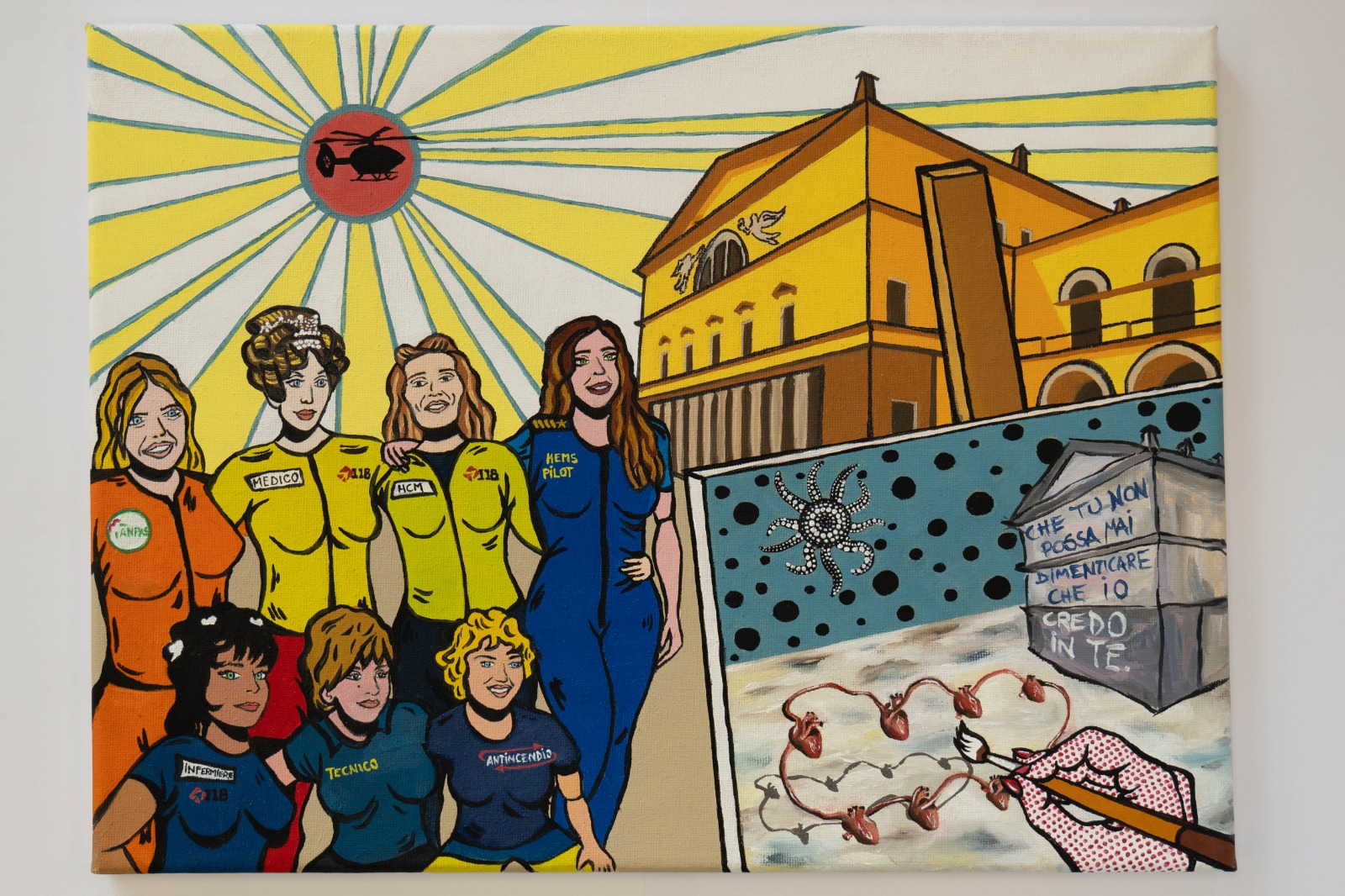
This canvas pays tribute to the city of Parma and Roy Lichtsteinen.
This painting is the last one I am working on, with which I will complete the project. I spontaneously kept it to the end because, compared to the others, I still didn’t have a clear idea about it.
I was determined to dedicate it to women. The artist I chose, Roy Lichtsteinen, often depicts women, but they are not always smiling; he often portrays them as sad and melancholic, suggesting that the reason for their suffering may stem from or depend on male attitudes.
While waiting for inspiration one day, watching “C’è ancora domani” (There is still tomorrow), a film by Paola Cortellesi set in 1946, I found the right ideas.
In the film, the protagonist is a housewife, a role she does not enjoy, a social condition linked to most women of the time, who were forced to take care of the housework and were financially dependent on men. I wanted to dedicate the painting to the theme of women as workers because I reflected that, in 100 years of history, the condition of women has changed a lot.
My grandmother lived the same life as the protagonist of the film, and now, only 50 years later, I find myself with a full-time job (which used to be considered “men’s work”), enough money to not depend on anyone, ideas to express, and passions to cultivate. Today, if I wanted to be a housewife, I could do so, but the important thing is that the choice is mine alone and not dictated by a system or social conditions.
For this reason, I included the Teatro Regio in Parma in the background of the canvas. It was strongly desired by Duchess Maria Luigia of Austria, whose face I depicted in the work, placing her among the working women embracing in the foreground on the left.
The key point of the theme is visible in the canvas: a woman’s hand paints what she sees, this hand represents and embodies three different visions of three important female artists: Yayoi Kusama, Charlotte Salomon, and Frida Khalo.
I chose these three women over many others because I think they best represent and embody the strength and courage to never give up. Kusama, despite being forced by her mother as a child to follow and monitor her father’s movements when he was with other women; Salomon, despite knowing that her fate was already sealed in a concentration camp where she died while pregnant; and Khalo, despite the suffering caused by physical surgery and her husband’s betrayals, never gave up painting.
Eleonora Ruggeri
Painter, Firefighter Bologna HEMS
This painting is the last one I am working on, with which I will complete the project. I spontaneously kept it to the end because, compared to the others, I still didn’t have a clear idea about it.
I was determined to dedicate it to women. The artist I chose, Roy Lichtsteinen, often depicts women, but they are not always smiling; he often portrays them as sad and melancholic, suggesting that the reason for their suffering may stem from or depend on male attitudes.
While waiting for inspiration one day, watching “C’è ancora domani” (There is still tomorrow), a film by Paola Cortellesi set in 1946, I found the right ideas.
In the film, the protagonist is a housewife, a role she does not enjoy, a social condition linked to most women of the time, who were forced to take care of the housework and were financially dependent on men. I wanted to dedicate the painting to the theme of women as workers because I reflected that, in 100 years of history, the condition of women has changed a lot.
My grandmother lived the same life as the protagonist of the film, and now, only 50 years later, I find myself with a full-time job (which used to be considered “men’s work”), enough money to not depend on anyone, ideas to express, and passions to cultivate. Today, if I wanted to be a housewife, I could do so, but the important thing is that the choice is mine alone and not dictated by a system or social conditions.
For this reason, I included the Teatro Regio in Parma in the background of the canvas. It was strongly desired by Duchess Maria Luigia of Austria, whose face I depicted in the work, placing her among the working women embracing in the foreground on the left.
The key point of the theme is visible in the canvas: a woman’s hand paints what she sees, this hand represents and embodies three different visions of three important female artists: Yayoi Kusama, Charlotte Salomon, and Frida Khalo.
I chose these three women over many others because I think they best represent and embody the strength and courage to never give up. Kusama, despite being forced by her mother as a child to follow and monitor her father’s movements when he was with other women; Salomon, despite knowing that her fate was already sealed in a concentration camp where she died while pregnant; and Khalo, despite the suffering caused by physical surgery and her husband’s betrayals, never gave up painting.
Eleonora Ruggeri
Painter, Firefighter Bologna HEMS